Functional CAD Design
The coaster was designed from scratch in Fusion 360 with a focus on real-world use, including the mounting shape, item storage area, and overall strength of the print.
Physical Builds · Functional Print
A fully completed 3D printed bedside organizer designed to attach to a bed frame and hold everyday items within easy reach.
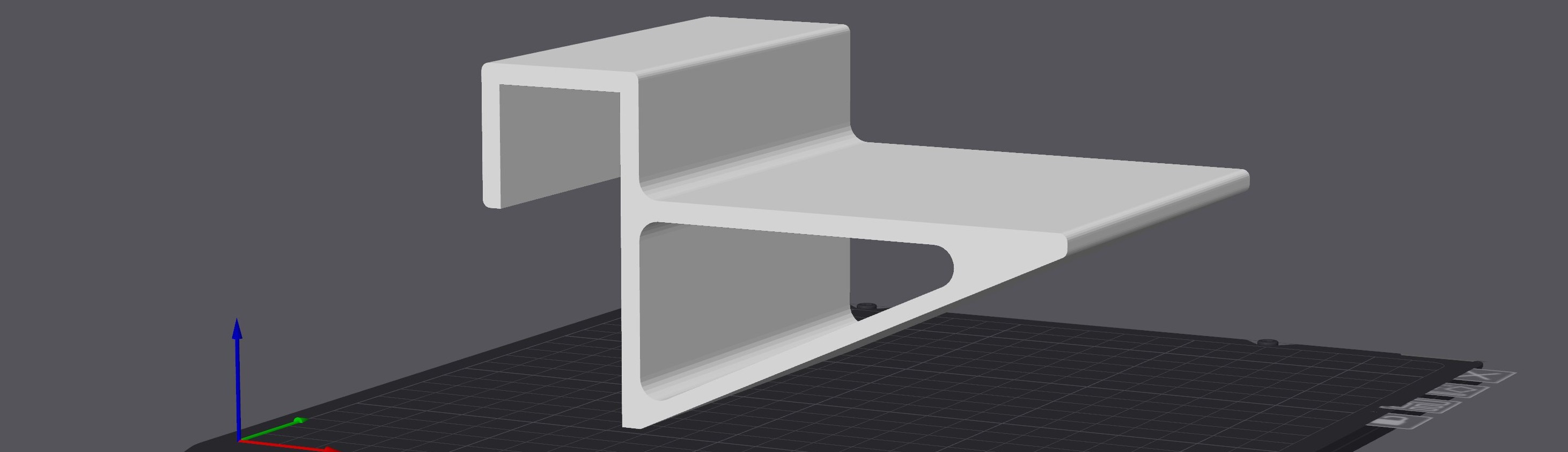
This is a fully completed functional 3D print designed in Fusion 360. The bedside coaster attaches securely to a bed frame and creates a small storage surface for a water bottle, phone, wireless charger, or other small items.
The goal was to create something minimal, practical, and easy to print without supports. Instead of taking up space with a bedside table, the coaster adds a compact surface directly to the bed frame, helping reduce nighttime clutter while keeping important items close by.
I designed the coaster from scratch in Fusion 360, focusing on the shape, mounting method, strength, printability, and everyday usability. I created multiple versions, tested the first design in real use, and improved the model based on what worked and what could be better.
The final version is one of my most successful functional prints. It works extremely well, prints efficiently, and solves a simple problem in a clean and practical way.
The Fusion 360 models, the printed second version, and a demo of it in use. Click to enlarge.
The coaster was designed from scratch in Fusion 360 with a focus on real-world use, including the mounting shape, item storage area, and overall strength of the print.
The model was designed to print cleanly without supports, making it more efficient, easier to produce, and better suited for repeated improvements.
The final coaster attaches to a bed frame and creates a compact space for items like a water bottle, phone, charger, or other small things needed at night.
This project helped me practice designing for a specific real-world problem instead of just making a decorative model. I had to think about how the coaster would attach, how much weight it could hold, how it would print, and how it would feel to use every day.
I also learned how useful small design iterations can be. The first version proved that the idea worked, and the second version improved the strength, fit, and overall practicality of the design.
This is one of my most successful functional 3D prints because it solves a real problem and continues to be useful after printing. It is simple, efficient, and practical, which makes it one of the designs I am happiest with.
The project showed me how satisfying it can be to design something small that directly improves a daily routine. Even though the coaster is not overly complicated, it works extremely well for what it was made to do.