Custom Minigames
BirdPlex included several original and recreated minigames, including Block Party, Bridge Wars, Bed Wars, Block Hunt, Dropper, Red vs Blue, and smaller experimental prototypes.
Game Development · 2019 to 2022
A Minecraft minigame server I built throughout high school, featuring custom lobbies, original maps, and gameplay systems made almost entirely with command blocks.
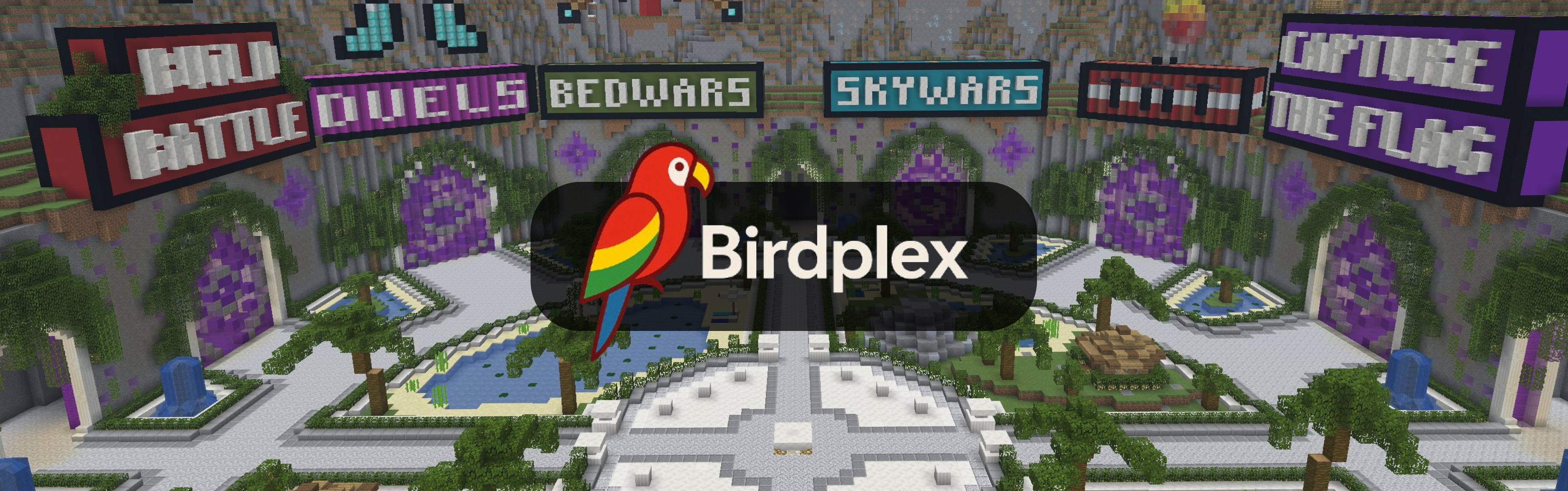
BirdPlex was a Minecraft server I worked on throughout most of high school, from around 2019 to 2022. It started as a creative server project and grew into a full minigame server with custom lobbies, original maps, and several playable game modes.
The server included minigames such as Block Party, Bridge Wars, Bed Wars, Block Hunt, Dropper, Red vs Blue, and several smaller experiments. Most of the mechanics were built using command blocks, which made the project a mix of game design, logic systems, map building, and creative problem solving.
BirdPlex was one of my most important early creative projects. It was not just about building maps in Minecraft; it was about trying to create a complete multiplayer experience with menus, lobbies, rules, scoring, custom mechanics, and replayable games. Looking back, a lot of the skills I use now started here: designing systems, testing mechanics, organizing large projects, solving technical problems, and making something feel polished even with limited tools.
Lobby builds, minigame maps, command block systems, and other parts of the BirdPlex server.
BirdPlex included several original and recreated minigames, including Block Party, Bridge Wars, Bed Wars, Block Hunt, Dropper, Red vs Blue, and smaller experimental prototypes.
All of the server's minigame logic was built using command blocks (in-game coding language). These systems controlled game rules, timers, map changes, player effects, scoring, teleporting, and other custom mechanics.
The server had a full central lobby, secondary areas, custom arenas, floating islands, PvP maps, and environmental builds designed to make the server feel complete and explorable.
One idea I considered for a future version of BirdPlex was adding AI-controlled players. The goal would be to make the server feel active even when no real players were online, allowing people to play minigames at any time without needing a full lobby.
These AI players would be designed to behave like real players: moving through maps, participating in games, reacting to objectives, and creating the feeling of a more populated server. This would make the experience more accessible for casual players and could help the server stand out from other Minecraft minigame servers.
BirdPlex is currently paused, but it is still one of the projects I would be interested in revisiting someday. A future version could rebuild the server with modern Minecraft tools, using data packs, plugins, or a cleaner server architecture instead of relying almost entirely on command blocks.
If I brought it back, I would want to keep the original spirit of the project while rebuilding the systems with everything I have learned since high school.
BirdPlex taught me a lot about game design before I had much formal programming experience. Building with command blocks forced me to think logically, break problems into smaller systems, test mechanics repeatedly, and find creative solutions inside the limits of Minecraft.
It also helped me learn how much work goes into making a game feel complete: not just the main mechanic, but the lobby, menus, maps, rules, feedback, timing, and small details that make players understand what to do.
This project is very nostalgic for me because it represents a huge part of my early interest in coding/programming, game development and interactive systems. Even though it is paused now, BirdPlex was one of the first projects where I tried to build something that felt like a full experience rather than just a single map or idea, and was also my informal introduction to coding (with the Minecraft command blocks).
It remains one of my foundational creative projects, and a lot of my later interest in software, games, UI systems, and technical design can be traced back to projects like this.