All my websites
Every website I run is hosted here, including this site and the Northern Ember site, with room for whatever I build next. They sit behind a reverse proxy so one machine can serve several domains at once.
Horizon Science · Built and Running
A dedicated home server I designed, specced, and built myself. It runs Unraid, hosts my websites and game servers, and is growing into the home for my media library, project databases, and backups, all on hardware I own and control.
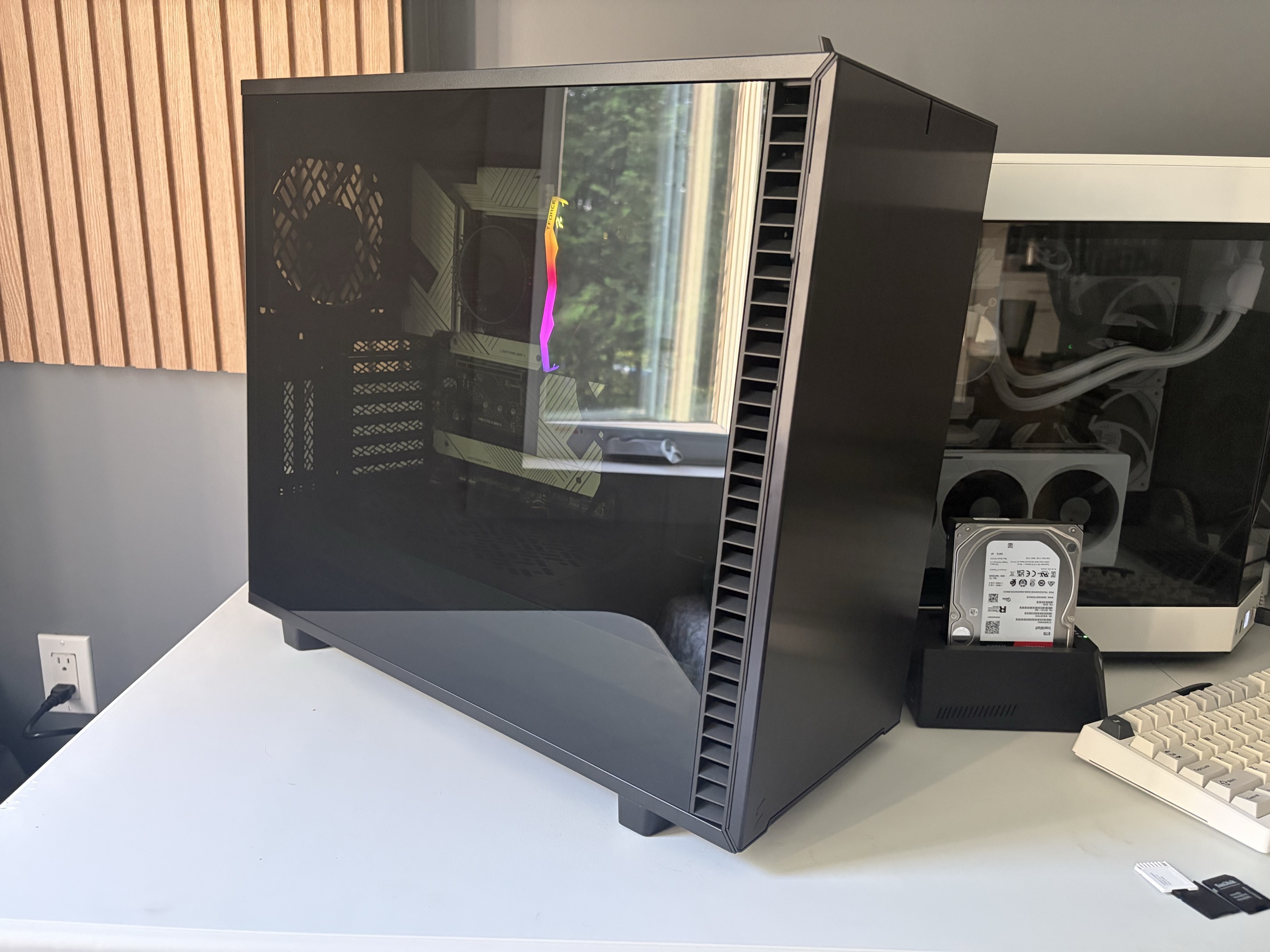
This started as a vague "personal cloud" idea that almost turned into a second gaming PC. I scrapped that and committed to a proper, dedicated server instead: cleaner, quieter, cheaper, and far less of a headache.
I picked every part myself and collected them over a few months, and it is now assembled and online, running quietly on the desk beside my main PC.
The server is assembled, running Unraid, and doing real work: it hosts my websites and a Minecraft server my friends and I play on. The one piece still to come is the bulk storage. My two 8TB drives are busy in my main PC processing a movie library right now, so they move over once that finishes.
The full parts list, chosen for quiet, low-power, always-on duty rather than raw speed.
What the build actually looks like with the side panel off.
The i5-14400 sits under its stock cooler with a single 16GB DDR5 stick beside it, and the Define 7 leaves three open memory slots and a stack of empty drive bays for later. Building in a case this roomy made cable management easy and leaves plenty of space for the storage still to come.
Those bays are empty on purpose. My two 8TB drives are still in my main PC working through a movie library, so they get installed here once that job is done. Everything the server does today runs from the NVMe SSD.
Unraid gives the server a web dashboard I can reach from any device on my network. Click either screen to view it full size. A few network details are blanked out.
Uptime, processor load and temperature, and memory use sit on one screen next to the containers that are running and the shares the storage is split into: one for app data, one for databases, one for websites, and one for the system itself.
Everything currently lives on the 1TB NVMe pool, which is barely touched at around 20GB used. Unraid reports each device's temperature and read and write activity, so it is easy to see the drive is healthy and idle. The bulk storage slots in beside it once the 8TB drives arrive.
The whole point of the build. Some of this is live today, the rest is close behind.
Every website I run is hosted here, including this site and the Northern Ember site, with room for whatever I build next. They sit behind a reverse proxy so one machine can serve several domains at once.
A Minecraft server for my friends and me, running as its own container so it can be updated, backed up, or restarted without touching anything else on the machine.
Next up is a dashboard I am building myself as the hub for my movies, shows, music, and calendar in one place, instead of juggling separate apps. The i5's built-in Quick Sync handles the video, so no graphics card is needed.
PostgreSQL and MariaDB for my websites and apps, including a real backend for the BCE Inventory Manager so its data can sync across devices.
Nextcloud or Seafile for my own OneDrive-style file storage and syncing, fully under my control instead of a paid subscription.
An MQTT broker, Node-RED, InfluxDB, and Grafana to collect and chart live data from the ESP32 controller behind the Horizon Solar Dashboard.
Unraid handles mixed-size drives, makes storage easy to expand, has great Docker support, and lets me add parity for redundancy later. It fits a storage-and-apps server better than a full Linux setup or a VM-focused system.
The NVMe SSD holds the things that change constantly (the OS, Docker apps, databases, and the media library's cache), while the hard drives hold the bulk: media, archives, file storage, and backups.
The motherboard has 2.5Gb Ethernet, so the plan is a 2.5Gb link between my main PC and the server for fast transfers, with Wi-Fi 6E as a backup. For moving terabytes of media, wired wins.
Each service runs in its own Docker container, so the websites, the game server, and anything I add later stay isolated. One can be updated or restarted without risking the rest.
The immediate one is storage. Once my 8TB drives finish their current job they move into the empty bays, and the media library and backups can move onto the server for good. After that comes more memory, going from 16GB to 32GB and eventually 64GB so it can run more services at once without thinking about it.
Longer term I want a proper UPS for clean power and safe shutdowns, more drives with parity for redundancy, and the rest of the apps on my list added one at a time rather than all at once. The nice part is that the hard work is done: it is built, it is running, and everything from here is just adding to it.